AU-IBAR Repository: Recent submissions
Now showing items 21-40 of 1036
-
Resilient African Feed and Fodder Systems (RAFFS) project Annual Report Reporting Period: 1st December 2022 to 30th November 2023
(2023)This report, ‘Engendering Greater Understanding to Set a Transformative Agenda for addressing Feed and Fodder Shortages on the African Continent,’ captures progress in executing the RAFFS project activities from 1 December ... -
Guidelines for establishment of the Apex Africa Dairy Alliance
(2025-07)The Dairy sector is one of the fastest-growing agricultural value chains in Africa and contributes significantly to the continent's Agricultural GDP, sometimes exceeding 30% in some countries. It is a high-value crop and ... -
Guidelines for establishing national level feed and fodder multi-stakeholder platforms (MSPS)
(2025-07)In response to recurring feed and fodder shortages that undermine livestock productivity and livelihoods, these Guidelines deliver a concise, adaptable blueprint for designing and operationalizing Multi-Stakeholder Platforms ... -
Pollination services: an untapped input for enhancing productivity in crops and Fodder essential for poverty alleviation and attainment of elusive nutrition targets and ecosystem biodiversity
(2025)Pollination serves as a basic pillar for 9.5% of the world’s agricultural food production, thereby improving the profitability and productivity of 75% of agricultural crops. Without pollinators,the human race and all of ... -
Guidelines for Feed and Fodder Data Management
(2023)The Guidelines for Feed and Fodder Data Management have been developed to address the critical data and digital capacity challenges affecting the feed and fodder sector across Africa. The sector faces data fragmentation, ... -
Feed and Fodder: Critical Input for Enhanced Livestock Productivity, Human Food an Nutrition Security, Livestock Sector Stability and Youth Employment
(2025)Globally two thirds (2/3) of arable land is for raising livestock, and fifty-four percent (54.4%)1of coarse grains (such as maize, sorghum, barley, millet, oats and rye) is purposively produced for feeding animals. This ... -
Empowering Women, Nourishing Livestock: AWARFA-N’s Journey to Sustainable Feed and Fodder Model in Somalia
(2025)AWARFA-N’s central strategy involves the bulk multiplication of improved energy and protein fodder varieties within Somalia’s wetlands. This includes the cultivation of Sugar Graze Sorghum, Improved Sweet Potato Vines ... -
Women Catalysing Change in the Animal Resources Sector
(2025)The African Women in Animal Resources Farming and Agribusiness Network (AWARFA-N) Nigeria is pioneering a transformative initiative to revolutionize feed and fodder production, empower women and strengthen the livestock ... -
Sowing seeds of change: how AWARFA-N Kenya is transforming Livestock Feed and Fodder
(2025)WARFA Network Kenya Limited (ANKL), a women led agricultural enterprise, is transforming East Africa’s livestock feed and fodder market by addressing inefficiencies in supply chains, promoting women’s economic empowerment, ... -
Women Driving Feed and Fodder Innovation in Cameroon: AWARFA-N’s Success Story
(2025)AWARFA-N Cameroon was established in December 2023 as a network of Cameroonian women working in the livestock and agribusiness sector. The organization’s mission is to become the leading provider of baled fodder in Cameroon, ... -
Nourishing Livestock, Enriching Lives: AWARFA-Zimbabwe’s Sustainable Fodder Initiative
(2025)AWARFA-N Zimbabwe is an organization dedicated to empowering women in agriculture. With a focus on the livestock sector, this organization aims to bridge the economic gap between genders and enhance the participation of ... -
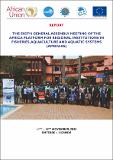
Report of the 8th General Assembly of the Africa Platform for Regional Institutions in Fisheries, Aquaculture and Aquatic Systems (APRIFAAS) 11 – 13 November, 2025 Entebbe, Uganda
(2025)Under the auspices of the African Fisheries Reform Mechanism (AFRM), the African Platform for Regional Institutions in Fisheries, Aquaculture and Aquatic Systems (APRIFAAS) was established in 2015 to strengthen institutional ... -
Africa Water Vision 2063 and Policy: a water secure and resilient Africa with safe sanitation for all
(2026-02-14)The Africa Water Vision 2063 provides a strategic framework to ensure sustainable water availability and safe sanitation as foundations for Africa’s socio-economic transformation. The Vision recognises water as a critical ... -
From Informal Livestock Corridors to Investable Trade Systems: Accelerating Pastoral Integration under AfCFTA
(2026-02-10)The policy brief proposes a practical 24-month corridor package to formalise Africa’s cross-border pastoral livestock trade and unlock investment. Despite its economic significance, the sector remains weakly integrated ... -
Report of the 2nd Pan African Donkey Conference: Africa's Commitment in Policy and Practice to Donkey Preservation: Now and in the Future - 26-27 June 2025
(2025-06)The Report of the Second Pan-African Donkey Conference (PADCO-2), Abidjan, 26–27 June 2025 captures Africa’s strengthened commitment to protecting donkey populations following the African Union moratorium on slaughter for ... -
Pan African Strategy for the Preservation of Donkey Species in Africa - 2026-2035
(2026)The Pan African Strategy for the Preservation of Donkey Species in Africa (2026–2035) provides a continental framework to safeguard donkey populations, enhance their welfare, and promote their sustainable utilisation across ... -
Strengthening PPR Eradication in Conflict-Affected/ Security-Fragile African Union Member States: A Strategy for Countries with Special Needs
(2025)This paper presents a continental strategy for eradicating Peste des Petits Ruminants (PPR) in conflict-affected and security-fragile African Union Member States. Developed by AU-IBAR technical experts in collaboration ... -
Proceedings of the Third AU-IBAR High level Coordination Meeting (AHCM): Transforming Africa’s Animal Resources through Integrated Value Chains and Strategic Partnerships; 27th November 2025, Virtual meeting
(2025)The meeting concluded with consensus on several key actions, including enhancing synergy between AU-IBAR and partner initiatives, refining the IRLVC Program with REC and Member State inputs, mobilizing coordinated financing ... -
The WTO Agreement on Fisheries subsidies: implications for Africa
(2025)The World Trade Organisation Agreement on Fisheries Subsidies is a novel instrument that has significant implications for the governance African member states territorial waters in respect of fisheries and ecosystem ... -
Sustainable growth of Aquaculture in Africa
(2025)Aquaculture in Africa presents significant potential for food security FAO (2022), job creation AU-IBAR (2019), and economic development World Bank (2019) and Bene & Heck (2005). However, the sector also faces critical ...